Lifecycle Marketing
Most businesses spend everything acquiring new customers and almost nothing keeping them. Clearwell's lifecycle marketing services build the automated systems that nurture leads, convert first-time buyers, retain existing customers, and maximize the lifetime value of every relationship.
Lifecycle Marketing Services
Acquiring a customer is the beginning, not the goal. The businesses that grow most efficiently are the ones that have a deliberate system for every stage of the customer relationship — from first touch through first purchase through long-term loyalty. Clearwell builds that system.
- Lead Nurture Sequences
- Onboarding & Welcome Flows
- Retention & Loyalty Programs
- Re-engagement & Win-back
- Customer Lifetime Value Strategy
- Automated Journey Architecture
Most Businesses Have an Acquisition Strategy and No Retention Strategy
Ask most business owners where their marketing budget goes and the answer is almost always the same. Google Ads. Facebook Ads. SEO. Lead generation. All of it pointed at one objective – getting new customers in the door.
Ask them what happens after a customer buys and the answer gets a lot less specific. Maybe a follow-up email. Maybe a check-in call if someone remembers to make it. Maybe nothing at all.
That imbalance is one of the most expensive mistakes in marketing. Research consistently shows that acquiring a new customer costs 5-7 times more than retaining an existing one. A 5% improvement in customer retention can increase profitability by 25% to 95%. And existing customers spend more, convert faster, and refer more often than new ones.
Yet the average business invests the overwhelming majority of its marketing budget in acquisition and almost nothing in the systems that maximize what happens after someone becomes a customer.
Lifecycle marketing changes that equation. It's the discipline of building deliberate, automated systems for every stage of the customer relationship, so every lead gets nurtured, every new customer gets onboarded properly, every existing customer stays engaged, and every lapsed customer gets a compelling reason to come back. The result is more revenue from the customers you already have, lower effective acquisition costs, and a marketing operation that compounds in value over time.
What Lifecycle Marketing Actually Means
Lifecycle marketing is the practice of delivering the right message to the right person based on exactly where they are in their relationship with your business – not where you hope they are or where they were six months ago.
A new subscriber who just downloaded your lead magnet is in a completely different place than a customer who has bought three times. A prospect who visited your pricing page twice this week has different needs than someone who signed up for your email list two years ago and has never opened anything since. Treating all of them with the same marketing is not just inefficient – it actively damages the relationship with the people who deserved something more relevant.
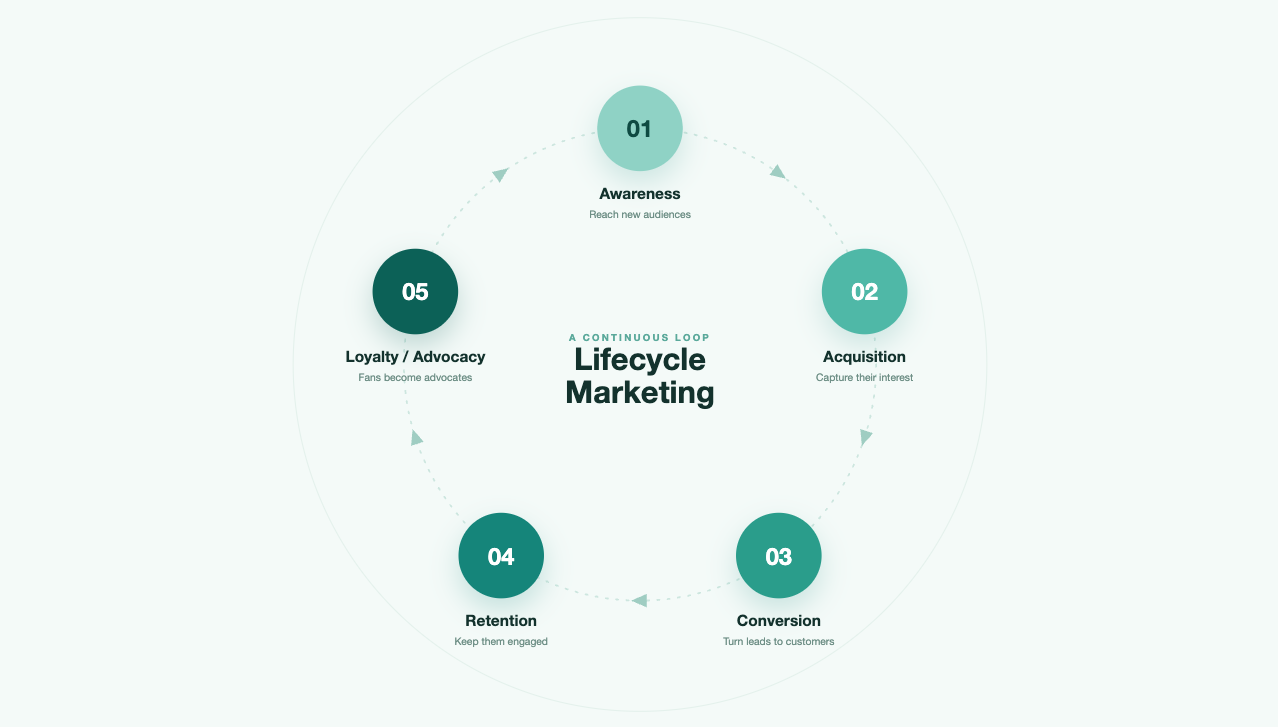
Lifecycle marketing maps the complete customer journey and builds specific, automated responses for each meaningful stage and transition within it. Every stage has its own objective, its own message, and its own measurement criteria. Together they form a system that works continuously – moving people forward in their relationship with your business without requiring manual intervention at every step.
The stages a complete lifecycle marketing system covers:
1) Awareness & Lead Capture
Getting the right people into your marketing ecosystem through lead magnets, opt-in forms, and the content and advertising that drives initial interest.
2) Lead Nurture
Converting subscribers and prospects into buyers through consistent, valuable communication that builds trust and moves the consideration process forward at the prospect's pace.
3) First Purchase Conversion
The specific messaging and offers that convert a warm prospect into a paying customer for the first time — often the most valuable stage to optimize because the improvements compound across your entire lead flow.
4) Onboarding
Setting new customers up for success through the communication and guidance that ensures a positive first experience — reducing early churn and creating the foundation for a long-term relationship.
5) Retention & Loyalty
Keeping existing customers engaged, purchasing regularly, and feeling valued through personalized communication, exclusive offers, and the recognition that builds genuine loyalty.
6) Re-engagement & Win-back
Identifying customers and subscribers at risk of churning or already lapsed and delivering the compelling, timely outreach that brings a meaningful percentage of them back.
7) Advocacy & Referral
Turning satisfied customers into active advocates through systematic referral programs, review requests, and the recognition that rewards and reinforces loyalty.
What Clearwell's Lifecycle Marketing Services Include:
Every lifecycle marketing engagement starts with mapping your current customer journey – understanding what happens at each stage, where people are falling through the cracks, and where automated systems would have the highest revenue impact.
Customer Journey Mapping
Before building anything we map your complete customer journey from first awareness through long-term advocacy — identifying every meaningful stage and transition, every touchpoint where communication currently exists or should exist, and every gap where customers are being lost due to the absence of a deliberate system. The journey map is the strategic foundation that every subsequent automation decision is built on.
Lead Nurture Sequence Development
The automated email and SMS sequences that move prospects from initial interest toward their first purchase — delivering consistent value, building credibility, and maintaining top-of-mind presence throughout a consideration period that may last days, weeks, or months depending on your business type. Every nurture sequence is written with the specific objections and decision criteria of your ideal customer in mind — not generic content that could apply to any business.
Welcome & Onboarding Flows
The communication a new customer receives in the first days and weeks after their first purchase determines whether they become a repeat buyer or a one-time transaction. We build onboarding flows that deliver product guidance, set expectations, create early wins, and build the relationship foundation that produces long-term retention — turning the post-purchase period from an afterthought into one of the highest-leverage stages in the customer lifecycle.
Retention & Loyalty Programs
Systematic programs that keep existing customers engaged, purchasing regularly, and feeling valued — through personalized communication based on purchase history and behavior, exclusive offers for loyal customers, milestone recognition at key relationship anniversaries, and the consistent value delivery that makes switching to a competitor feel like a meaningful loss rather than an easy decision.
Re-engagement & Win-back Campaigns
Every customer database accumulates lapsed customers over time — people who bought once and disappeared, subscribers who stopped engaging, clients who moved to a competitor. We build systematic re-engagement programs that identify these segments, deliver compelling outreach at the right moment, and recover a meaningful percentage of lapsed relationships at a cost far lower than acquiring equivalent new customers through paid channels.
Referral & Advocacy Programs
Satisfied customers are your highest-converting marketing channel — and most businesses never systematically activate them. We design and implement referral programs, review generation systems, and advocacy communications that turn your best customers into active ambassadors — generating a consistent stream of warm referrals and social proof that amplifies every other marketing investment you make.
Segmentation & Personalization Architecture
The infrastructure that makes lifecycle marketing genuinely personalized rather than just automated. We design the segmentation architecture that divides your customer and prospect base into meaningful groups based on behavior, purchase history, engagement level, and lifecycle stage — and build the personalization logic that ensures every automated communication feels relevant to the specific recipient rather than generic.
Lifecycle Analytics & Revenue Attribution
The measurement framework that shows what your lifecycle marketing system is actually producing — customer lifetime value by acquisition source, retention rates by customer segment, revenue attributed to specific automation sequences, and the key metrics that identify where the system is working and where it needs improvement. Monthly reporting covers lifecycle performance across every stage with plain-English interpretation and specific optimization priorities.
Why Lifetime Value Changes Everything About How You Think About Marketing
Most businesses calculate marketing ROI based on the first transaction. A Google Ad costs $50 in spend per lead and the first transaction is worth $500 – so the ROI is 10x and the campaign is profitable.
But what if that customer buys again three months later and again six months after that? What if they refer two other customers who each make multiple purchases? The actual value of that first $50 lead could actually be $5,000 or more depending on the lifetime of the relationship.
Understanding and maximizing customer lifetime value (CLV) changes how you think about acquisition costs, channel investment, and where your marketing dollars go. A business that knows its average customer lifetime value is $3,000 can profitably spend significantly more to acquire a customer than a competitor who is only thinking about the first transaction and believes acquisition costs that look the same are only worth $500.
Lifecycle marketing is the discipline that actually produces the high lifetime value that makes aggressive acquisition investment justifiable. Without the retention systems, the onboarding flows, the loyalty programs, and the win-back campaigns, customers churn faster, buy less frequently, and refer rarely. With retention, lifetime value compounds and every acquisition dollar works proportionally harder.
The businesses with the most efficient marketing operations are almost always the ones that have invested in both acquisition and retention, understanding that both sides of the equation multiply each other, not compete for the same budget.
How Lifecycle Marketing Looks Different for Different Businesses
The principles of lifecycle marketing are universal. The specific systems that deliver on those principles look different depending on what you sell, how your customers buy, and what the natural rhythm of the customer relationship is.
Service Businesses & Professional Services
For service businesses lifecycle marketing is primarily about relationship maintenance and referral generation. The customer relationship is often high-touch and high-value but episodic, that is that clients may not need your services continuously but when they do they should think of you immediately and when they know someone who needs your services they should refer you without hesitation. The highest-leverage lifecycle investments for service businesses are post-engagement follow-up sequences, annual check-in communications, and systematic referral programs.
eCommerce Businesses
For product-based businesses lifecycle marketing is a direct revenue driver – abandoned cart sequences, post-purchase flows, replenishment reminders, and win-back campaigns all generate directly attributable revenue. The purchase cycle determines the automation architecture. A consumable product with a 30-day usage cycle needs a different replenishment reminder strategy than a durable product with a 2-year replacement cycle. We work with Klaviyo and other platforms for eCommerce Lifecycle Marketing.
B2B Businesses
For B2B companies with longer sales cycles and multiple stakeholders lifecycle marketing covers both the pre-purchase nurture journey, and the post-sale retention and expansion journey. The nurture sequences need to be more educational, the onboarding more structured, and the retention communication more account-focused than individual-focused. The referral opportunity in B2B is also significant — a single satisfied B2B customer with a strong professional network can generate multiple high-value referrals if systematically activated.
Local Service Businesses
For local businesses serving a specific community lifecycle marketing builds the local reputation and word-of-mouth engine that drives sustainable growth. Review generation systems, referral programs, seasonal re-engagement campaigns, and the consistent community presence that keeps your business top-of-mind between service interactions are the highest-value lifecycle investments for local businesses. The goal is to become the obvious choice in your community – the business everyone recommends without being asked.
Lifecycle Marketing Services Are Right for Your Business If...
- You're spending heavily on customer acquisition but have no systematic approach to retaining the customers
- Your repeat purchase rate or client retention rate is lower than you know it should be
- You have (or don't have and need) an email list and a customer database that you're not using to generate repeat business
- Your customers say they're happy but aren't referring you as consistently as would suggest
- You're losing customers to competitors and aren't sure why or aren't doing anything to win them back
- You want to increase revenue without proportionally increasing your marketing spend on acqusition
- You understand that most efficient growth comes from maximizing what you already have before spending more
Why Choose Clearwell for your Lifecycle Marketing
Lifecycle Marketing involves strategy, copywriting, automation technology, and data analysis. Most agencies that offer it are strong in the technology, where they know how to build flows in Klaviyo or HubSpot or ActiveCampaign, but lack the strategic depth to design the customer journey architecture that makes those flows genuinely effective.
The technology is the easy part. The hard part is understanding your customers well enough to know what they need to hear at each stage of their relationship with your business, sequencing that communication in a way that feels natural rather than mechanical, and writing it in a voice that sounds like your brand rather than an automation template.
We manage every lifecycle marketing engagement with over 18 years of experience across the full customer journey for businesses in multiple categories. Every automation sequence is designed around your specific customer journey, written with your specific brand voice, and measured against the specific business outcomes it's supposed to drive.
We also build lifecycle marketing as part of a complete marketing strategy rather than an isolated channel. Your lifecycle sequences connect to your paid advertising audiences. Your win-back campaigns inform your acquisition targeting. Your referral programs amplify your organic reach. That integration is what produces compounding growth rather than incremental improvement in isolated metrics.
Frequently Asked Questions – Lifecycle Marketing
Email marketing is a channel — the tool used to deliver communication. Lifecycle marketing is a strategy — the deliberate design of what to communicate, to whom, and when based on where each person is in their relationship with your business. Email is the most common channel for delivering lifecycle marketing communication but lifecycle marketing also uses SMS, direct mail, paid retargeting, phone outreach, and in-app messaging depending on the business type and the stage being addressed. The distinction matters because lifecycle marketing is a strategic framework that transcends any single channel — email marketing without lifecycle strategy is just sending campaigns on a schedule.
Platform selection depends on your business type and existing tech stack. For eCommerce businesses on Shopify we almost always recommend Klaviyo — its behavioral trigger capability and Shopify integration depth are unmatched for eCommerce lifecycle marketing. For service businesses and B2B companies we typically recommend HubSpot or ActiveCampaign depending on CRM requirements and budget. For businesses already using GoHighLevel we build lifecycle sequences natively within GHL. We recommend the platform that best fits your situation rather than defaulting to a single tool regardless of fit.
A foundational lifecycle system — covering the core stages of lead nurture, welcome and onboarding, and a basic re-engagement campaign — typically takes four to six weeks to design, build, and test. A comprehensive lifecycle architecture covering every stage from awareness through advocacy, with full segmentation and personalization logic, typically takes eight to twelve weeks. Ongoing optimization begins immediately after launch as real customer behavior data reveals what is working and what needs adjustment.
The primary metrics are customer lifetime value, repeat purchase rate or client retention rate, and revenue attributed to specific automation sequences. We also track engagement metrics within each sequence — open rates, click rates, conversion rates at each stage — and use that data to identify where customers are dropping off and what changes would improve progression. Monthly reporting covers all of these with plain-English interpretation rather than data without context.
Absoluteley – and in some ways a smaller, more manageable customer base makes it easier to implement lifecycle marketing thoughtfully. The principles apply regardless of scale. A business with 200 customers benefits from systematic onboarding, retention communication, and referral programs just as much as one with 20,000 — the automation architecture is simply smaller. The revenue impact of improving retention and lifetime value is proportionally similar regardless of business size.
A CRM is the tool that stores customer data and manages the pipeline. Lifecycle marketing is the strategy that determines what to do with that data — what to communicate, when, through which channel, and with what objective at each stage. A CRM without lifecycle marketing strategy is a database. Lifecycle marketing without a CRM is strategy without infrastructure. The two are complementary — the CRM provides the data and automation capability that lifecycle marketing strategy directs.
We work with your existing platform wherever possible. Most major email and marketing automation platforms — Klaviyo, HubSpot, ActiveCampaign, Mailchimp, GoHighLevel — are capable of delivering sophisticated lifecycle marketing sequences. We assess your current platform's capability against your lifecycle marketing requirements and recommend a migration only if the gap between what your platform can do and what your strategy requires is significant enough to justify the disruption of switching.
It depends on your specific situation — which is why every engagement starts with a free assessment rather than a standard recommendation. That said for most businesses the highest-impact starting point is either the post-purchase onboarding sequence — because improving early customer experience reduces churn that is already happening — or the win-back campaign — because recovering lapsed customers from an existing database generates immediate revenue with no acquisition cost. We identify your specific highest-leverage starting point during the initial audit and sequence the build accordingly.

More Revenue From the Customers You Already Have
Growth doesn’t always come from spending more on acquisition. Sometimes it comes from building better systems around the customers you already have. Request a free lifecycle marketing assessment and find out exactly where your customer journey has gaps and what it would take to close them.
